

How to build multimedia structures with transparent Infiled HOLO LED curtains
A practical guide for designers, scenographers and technical production teams

Transparent LED curtains are often described by numbers.
Pixel pitch.
Brightness.
Transparency.
Weight.
Refresh rate.
IP rating.
All of these things matter.
But if you are a scenographer, exhibition designer, creative agency or technical production company, the real question is much more practical:
What can I actually build with it?
That is where INFiLED HoloLight becomes interesting.
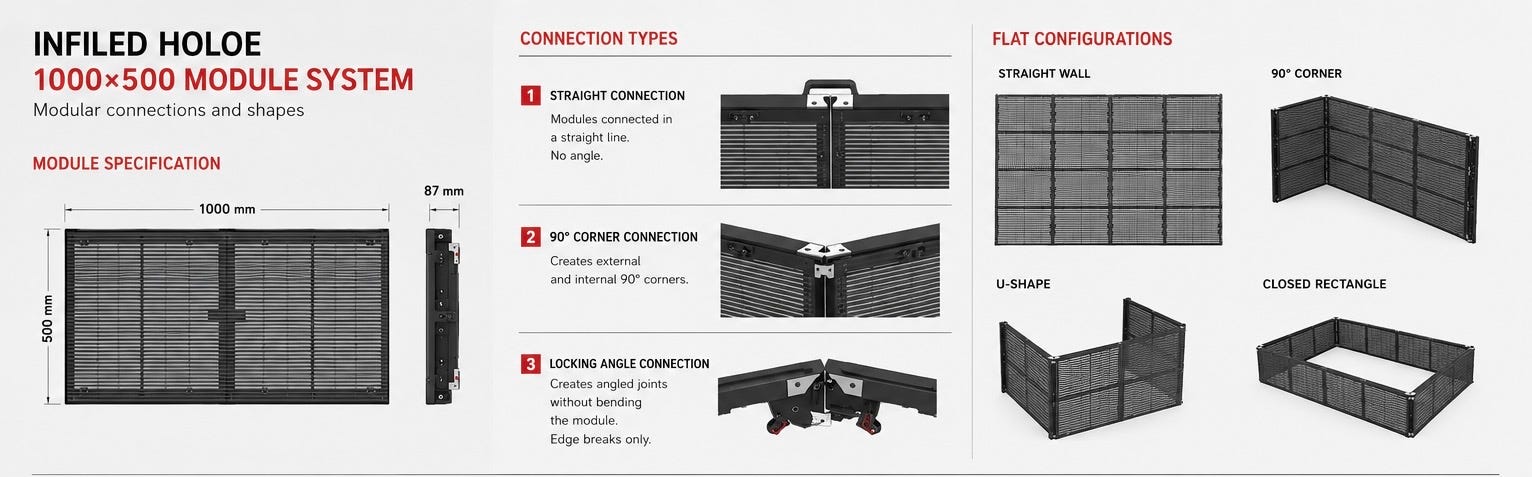
It is not just a transparent LED screen. It is a modular scenic material that can be used to create walls, corners, cubes, arcs, cylinders, pop-up structures and large multimedia scenography.
This article is not a product catalogue.
It is a practical guide to thinking about how to connect, mount and design structures using transparent LED curtains.
The examples are based on the INFiLED HoloLight HL3978 system available from A-RENTAL. The system is designed for creative rental applications, including concerts, festivals, sports, exhibitions and brand environments.
For more technical context and rental availability, you can explore transparent LED curtain rental solutions for exhibitions, concerts and multimedia scenography.
The main building block: 1000 × 500 mm
The primary module is:
1000 × 500 mm
This is the base module for most structures.
Use it for:
large straight walls,
exhibition stand façades,
stage backdrops,
brand zones,
cubes,
rectangular structures,
larger scenic surfaces.
Most of the design should be based on this module.
It keeps the layout clean, efficient and scalable.
The support module: 500 × 500 mm
There is also a smaller module (available in lower quantity comparing to 1000x500mm)
500 × 500 mm
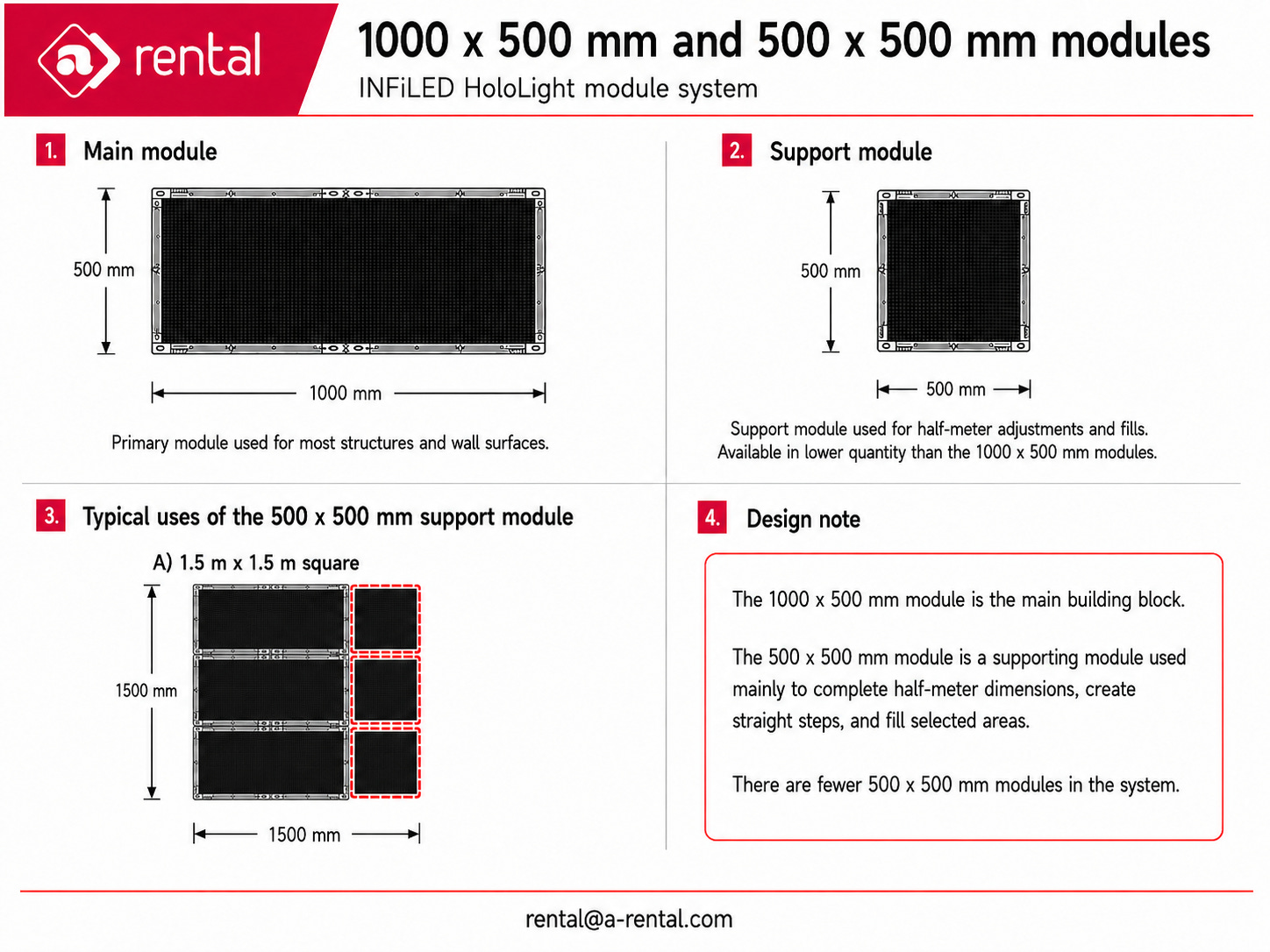
This module should be treated as a support module, not the main building block.
It is used in smaller quantities and is useful for:
half-metre adjustments,
1.5 m wide surfaces,
1.5 m high surfaces,
edge filling,
selected details,
completing irregular layouts.
A simple way to think about it:
1000 × 500 mm = main module
500 × 500 mm = support and filling module
This is useful for designers because it gives more freedom without breaking the modular logic.
Straight walls and flat surfaces
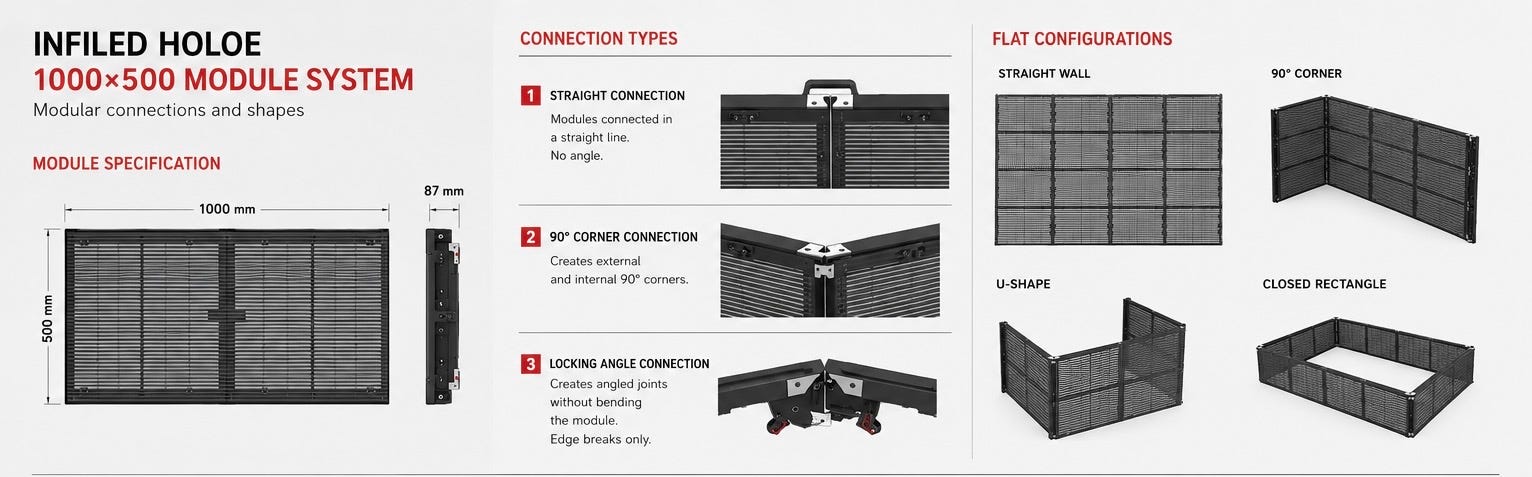
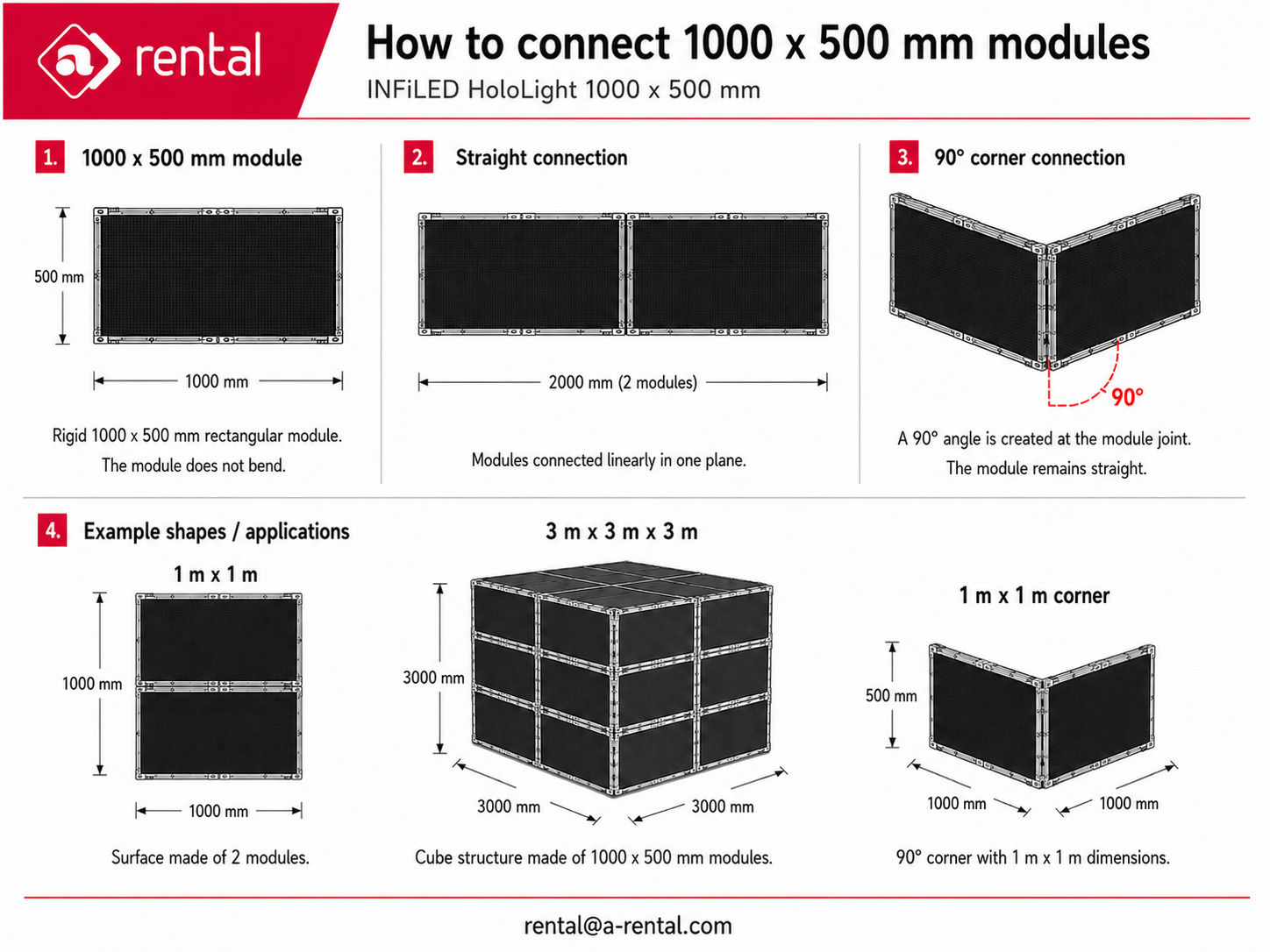
The easiest structure is a straight wall. Modules are connected side by side in one plane.
This can create:
transparent LED walls,
booth façades,
media backdrops,
product presentation walls,
temporary visual barriers,
stage wings,
internal partitions.
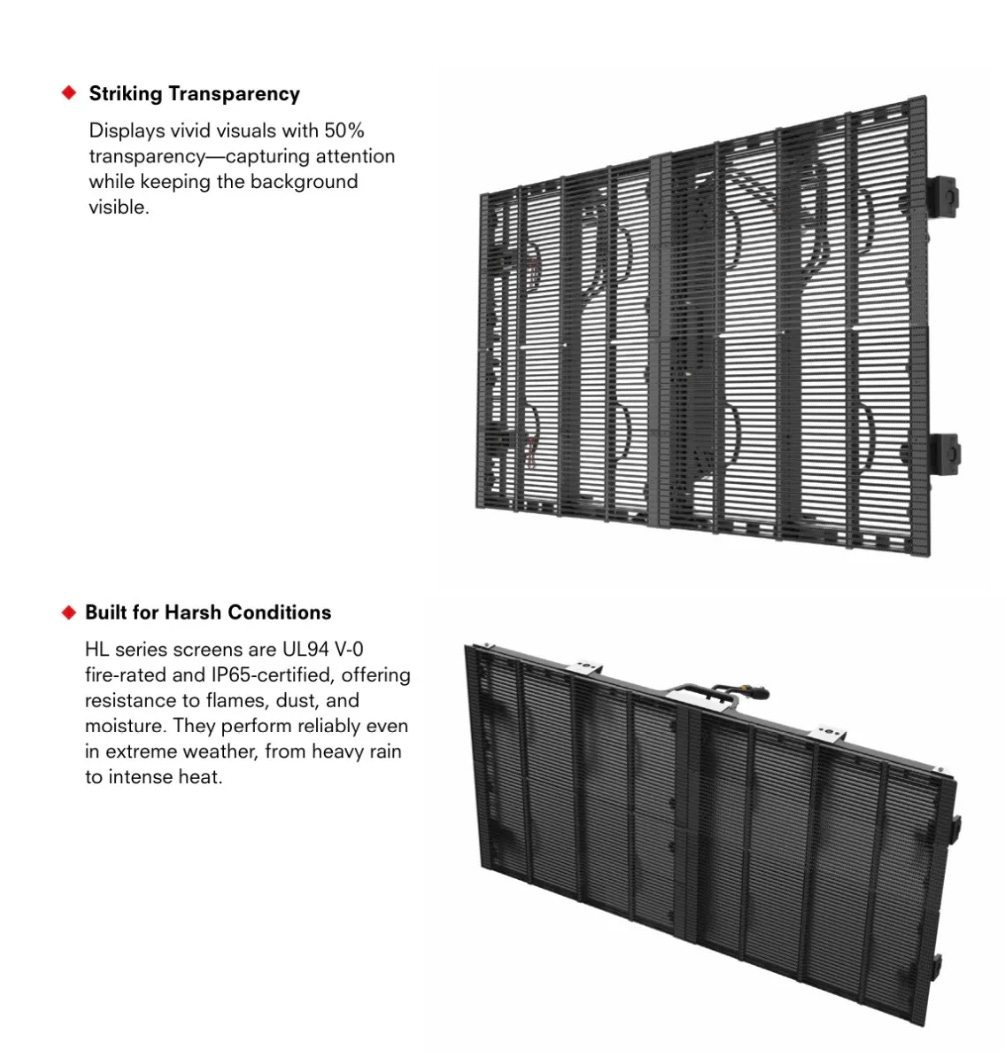
Because the system has around 50% transparency, the wall does not fully close the space.
People, products, light and movement remain visible behind it.
That is a huge advantage for exhibition stands.
The booth can attract attention from a distance, while still feeling open and inviting.
This is one of the reasons why transparent LED is becoming increasingly relevant for modern multimedia exhibition stands and modular LED booth structures.
90-degree corners
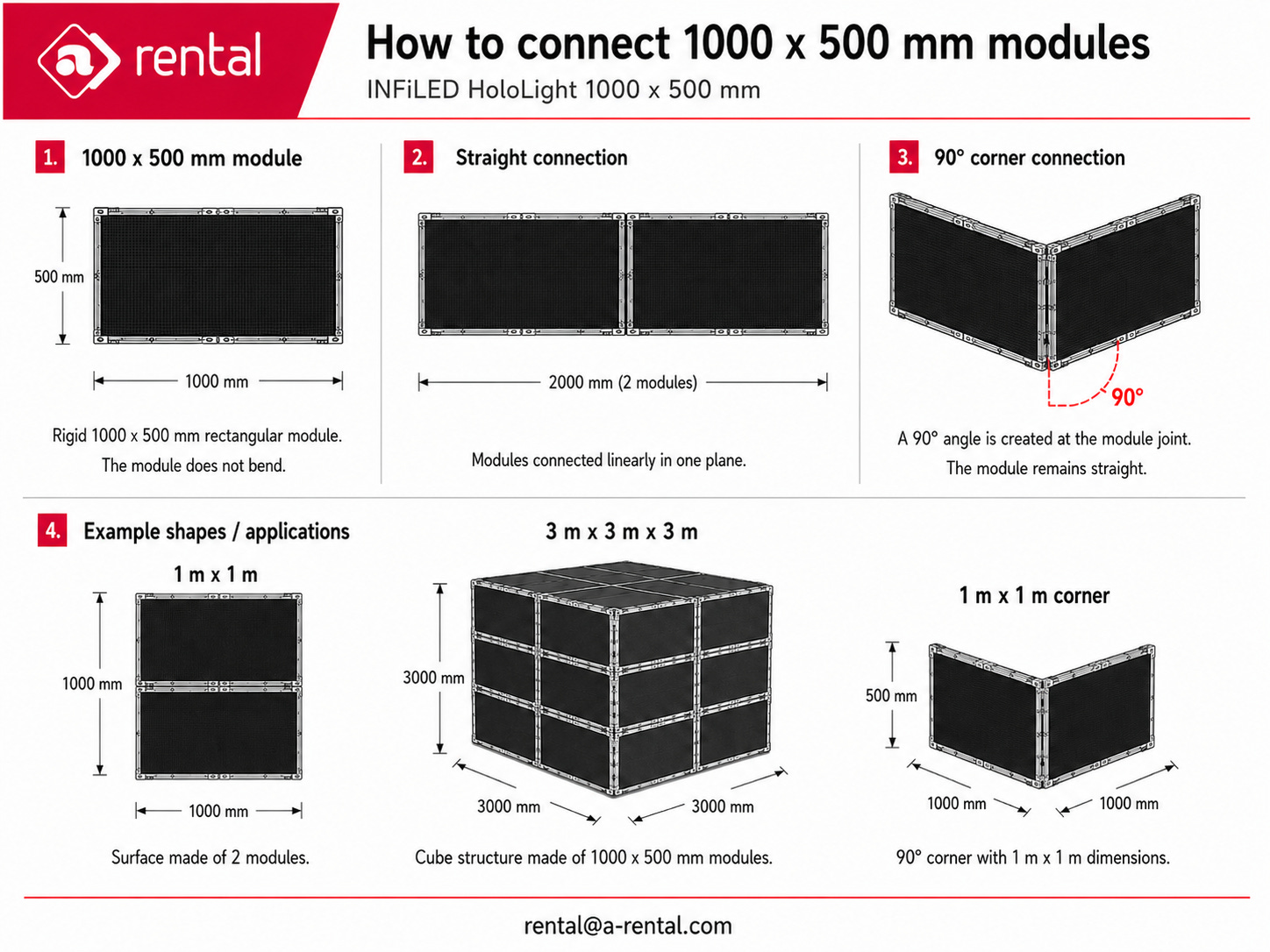
The next step is the 90-degree corner connection.
This is what turns a flat wall into architecture.
With 90-degree corners, you can build:
L-shaped walls,
U-shaped structures,
square corners,
cubes,
rectangular rooms,
pop-up pavilions,
perimeter walls around a stand.
A simple 1 × 1 m corner can already show the logic.
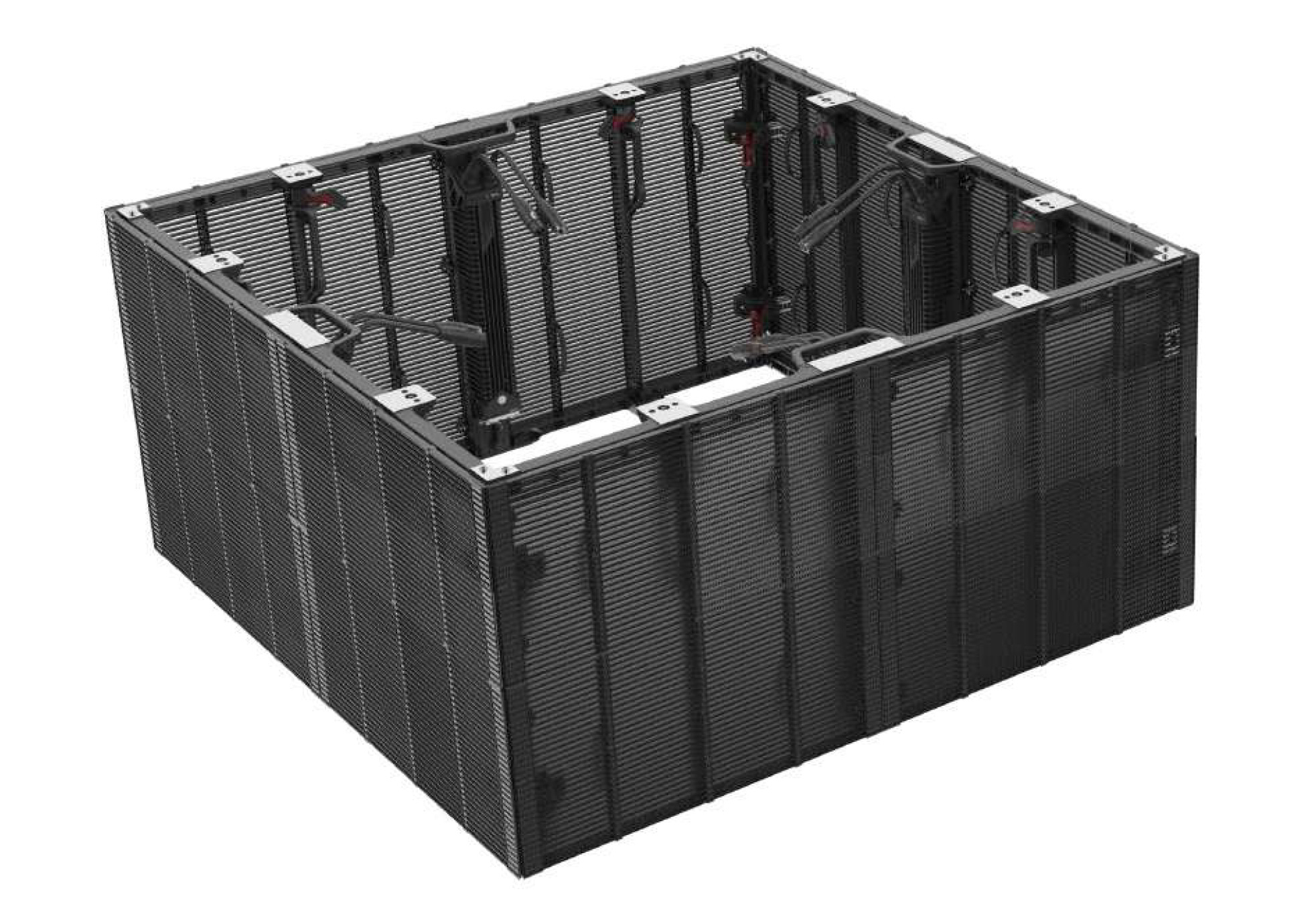
Scale it up, and the same idea becomes a 3 × 3 × 3 m cube, a 10 × 16 m booth façade or a much larger scenic structure.
This is where transparent LED stops being “a screen” and starts becoming a spatial design tool.
Curved shapes and cylinders
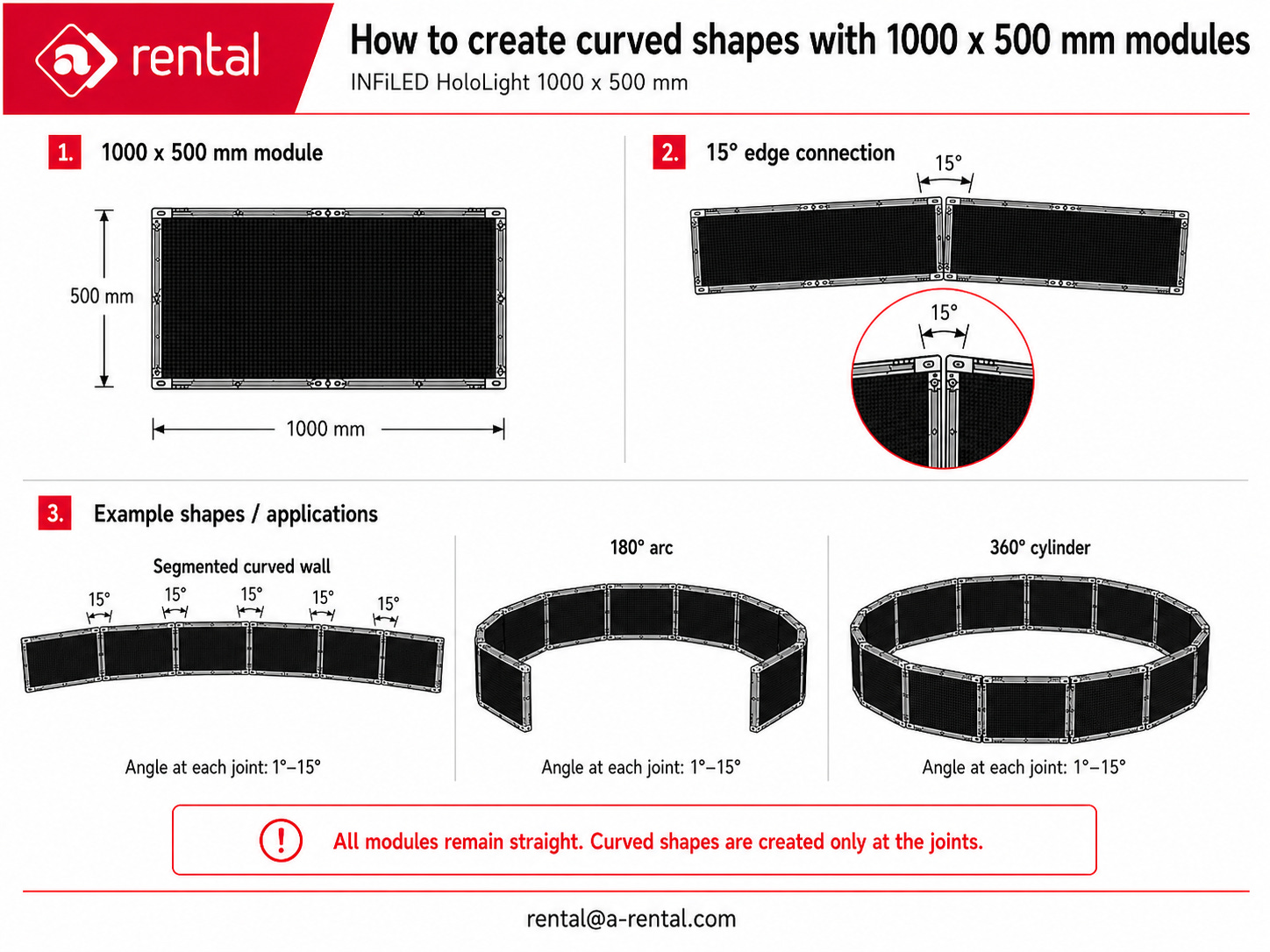
Curves are possible, but they need to be planned correctly.
A HoloLight module is a rigid LED cabinet.
The module itself stays straight.
The curve is created at the connection between modules.
The HoloLight system allows angled connections from -15° to +15°, adjustable in 2.5° steps.
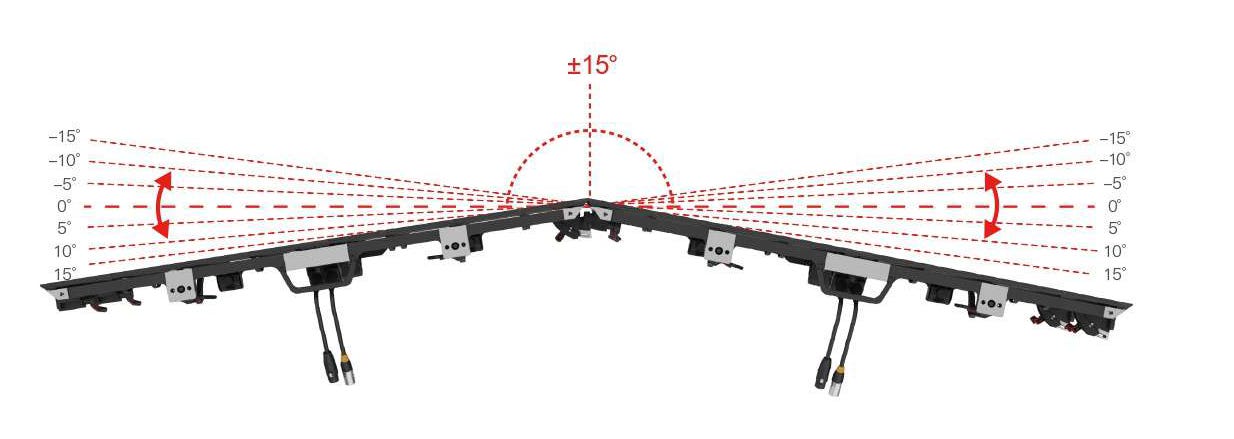
This makes it possible to create:
segmented curved walls,
soft arcs,
cylindrical structures,
circular brand zones,
semi-circular façades,
rounded scenic objects.
The smaller the angle between modules, the wider and softer the curve.
The larger the angle, the tighter the shape.
For more inspiration around large-format scenic systems and production thinking, you can also read practical event technology insights for multimedia stages, exhibition stands and live production.
Hanging, stacking and structure
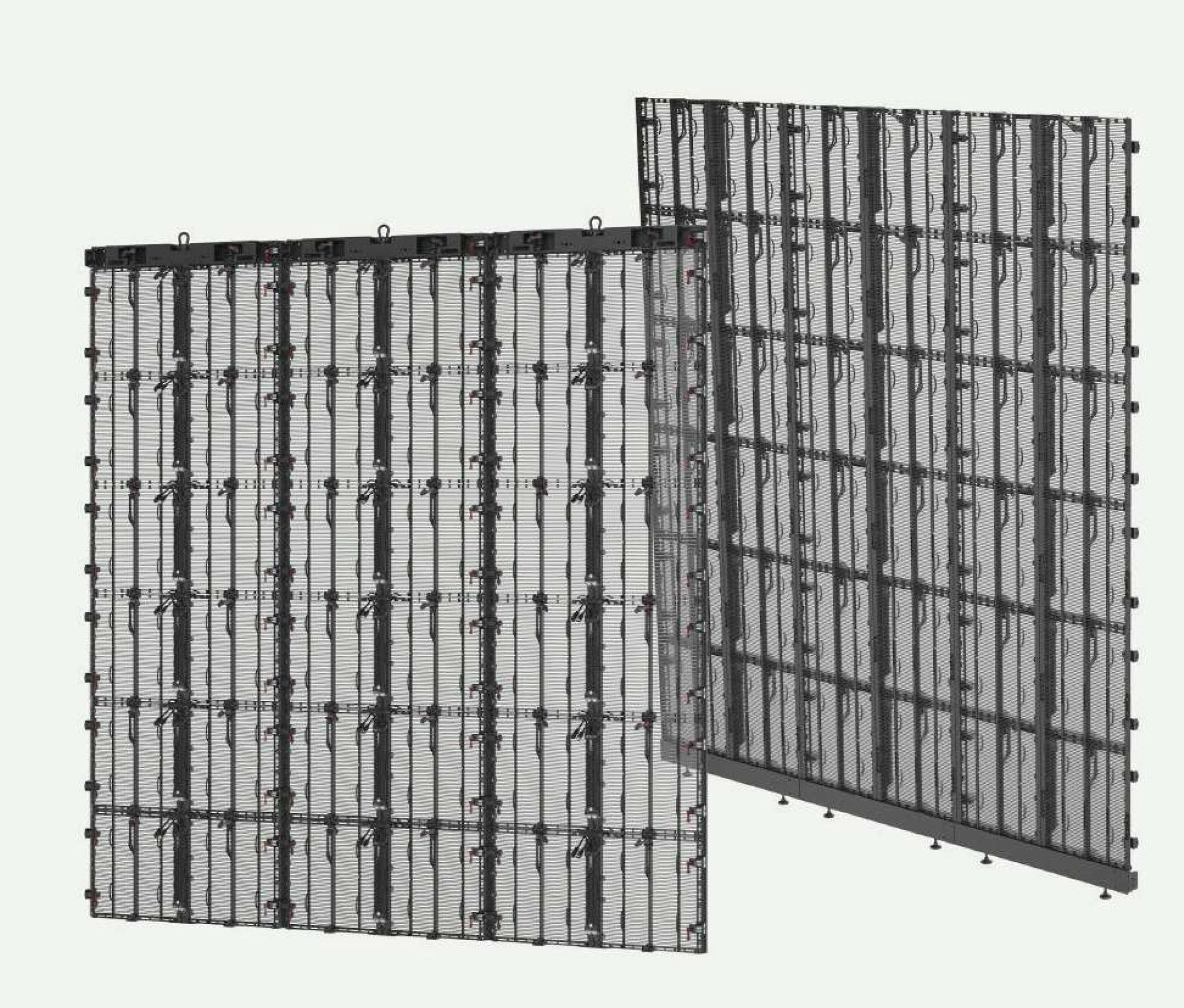
HoloLight is made for rental use, so the system is designed for repeated assembly.
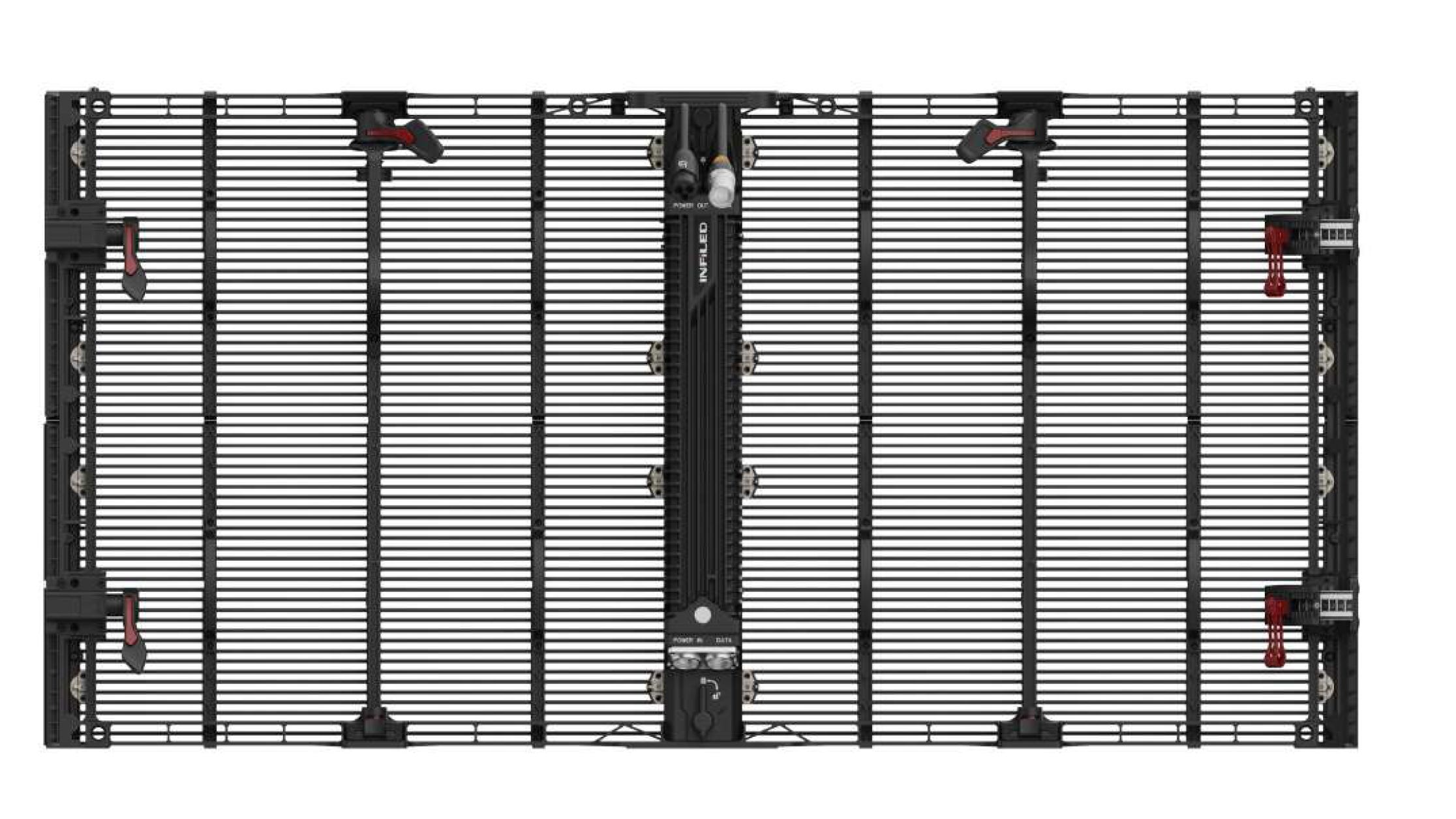
The 1000 × 500 mm cabinet weighs around 7.5 kg and can be used in hanging or stacking configurations.
In real projects, the system can be:
flown from truss,
ground-supported,
built into scenic frames,
used as a booth façade,
integrated into pop-up structures,
combined with other event technologies.
The mounting method should always be selected based on the project.
Is it indoor or outdoor?
How tall is the structure?
Is it exposed to wind?
Where is the load going?
Can the team service it easily?
These questions should come early, not at the end.
Locks, alignment and fast setup
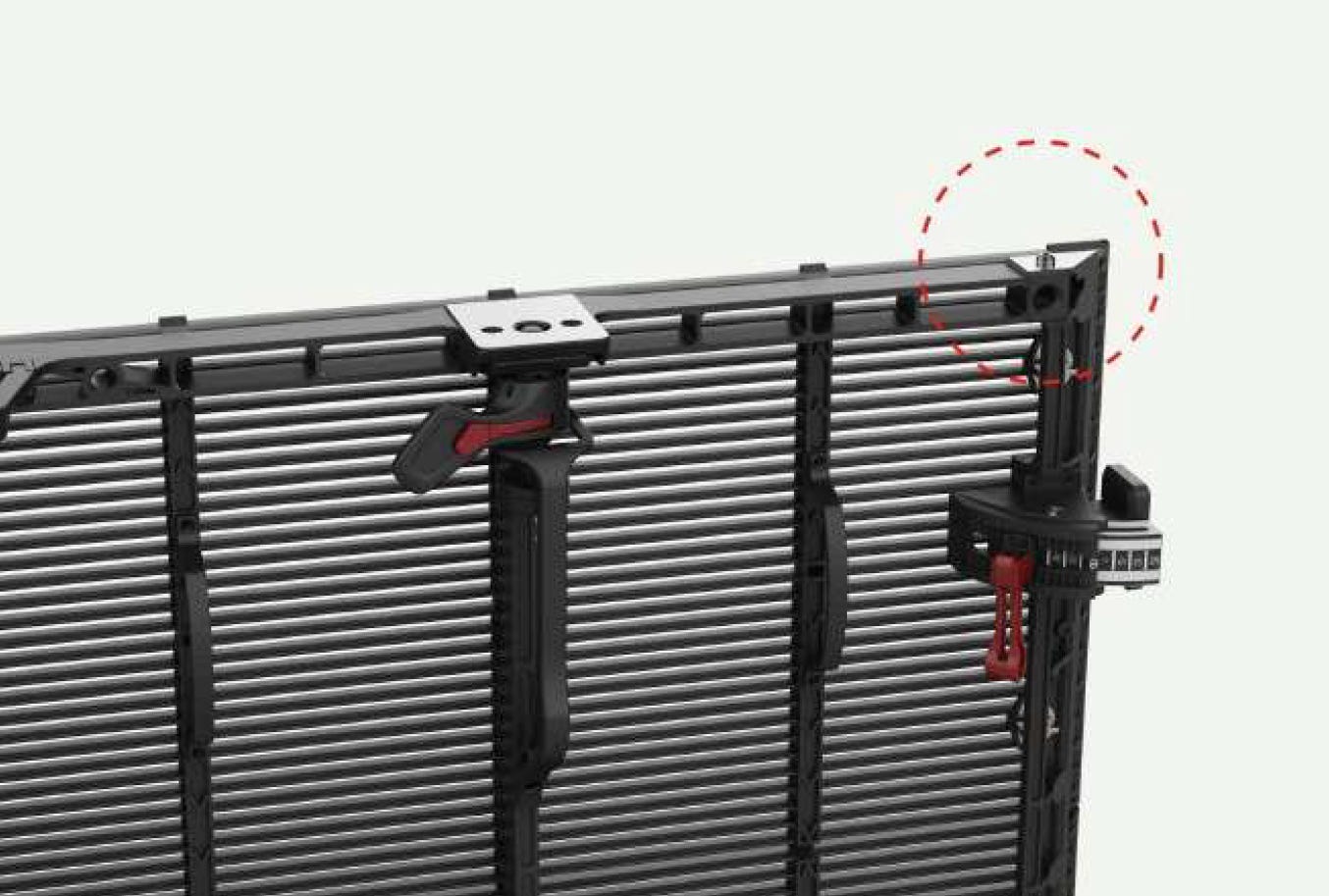
For technical teams, connection quality is everything.
A rental LED system must be fast to install, but also stable and repeatable.
HoloLight uses positioning pins and a pre-lock mechanism, which help with cabinet alignment and faster setup.
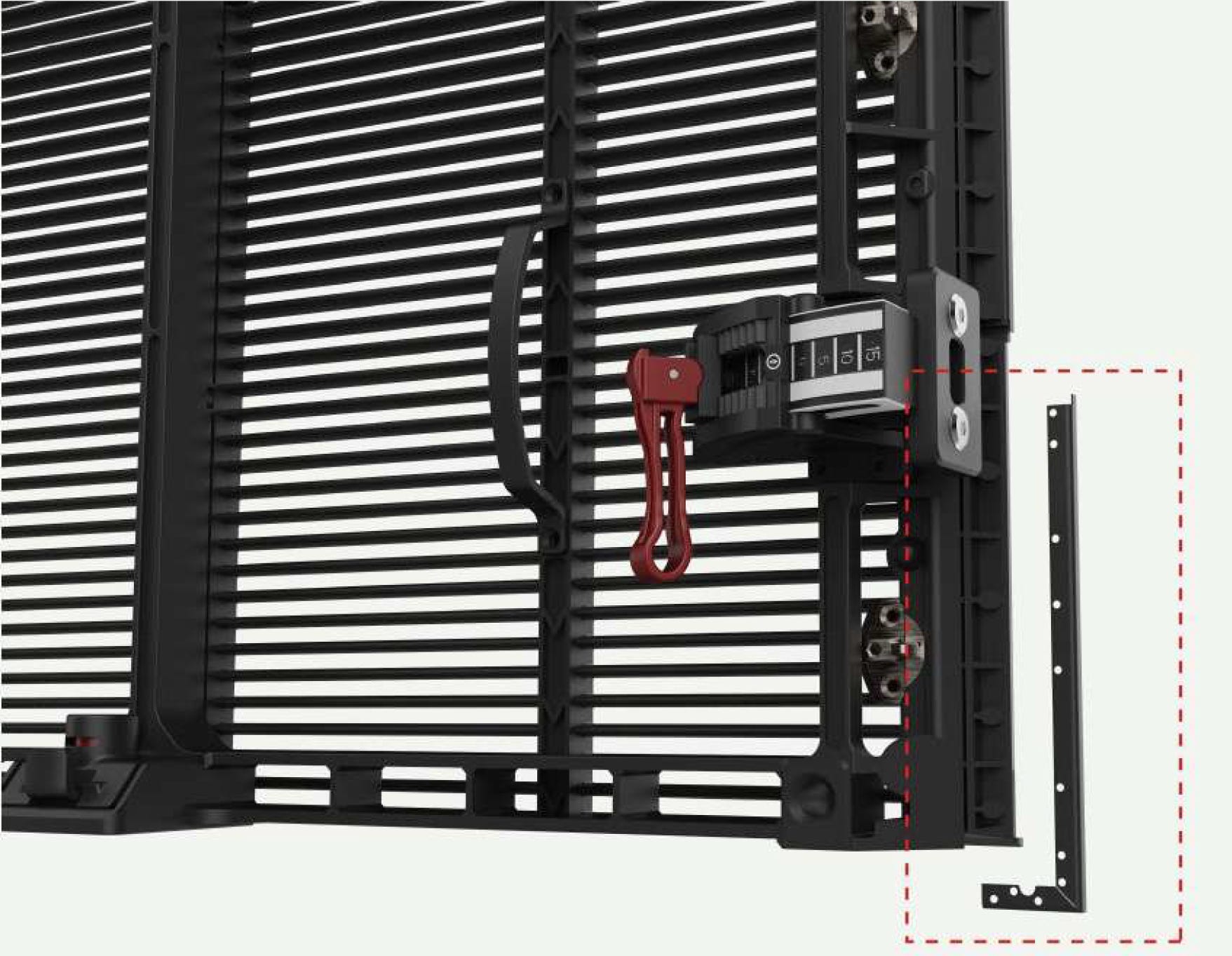
In practice, the workflow looks like this:
Define the geometry.
Decide where straight, 90-degree and angled connections are needed.
Prepare the supporting structure.
Start from a clean, level first row or hanging line.
Use locks and positioning pins for alignment.
Connect power and signal.
Check mapping and orientation.
Test content and camera performance.
Confirm access for service.
Transparency: why 50% matters
One of the biggest advantages of transparent LED curtains is not only what they display.
It is what they allow you to see through them.
With around 50% transparency, the structure can work as a large multimedia surface without completely closing the space behind it.
For exhibition stands, stage designs and brand environments, this is very important.
Visitors can still see:
products behind the screen,
people inside the stand,
lighting and scenic layers,
movement and activity,
the depth of the whole installation.
This creates a much lighter and more architectural feeling than a traditional solid LED wall. The content attracts attention from a distance, while the transparency keeps the space open and inviting.
It also helps in outdoor and semi-outdoor projects, because the surface allows air to pass through. That does not replace proper engineering, but it can reduce wind impact compared to a fully solid LED wall.
Service access matters
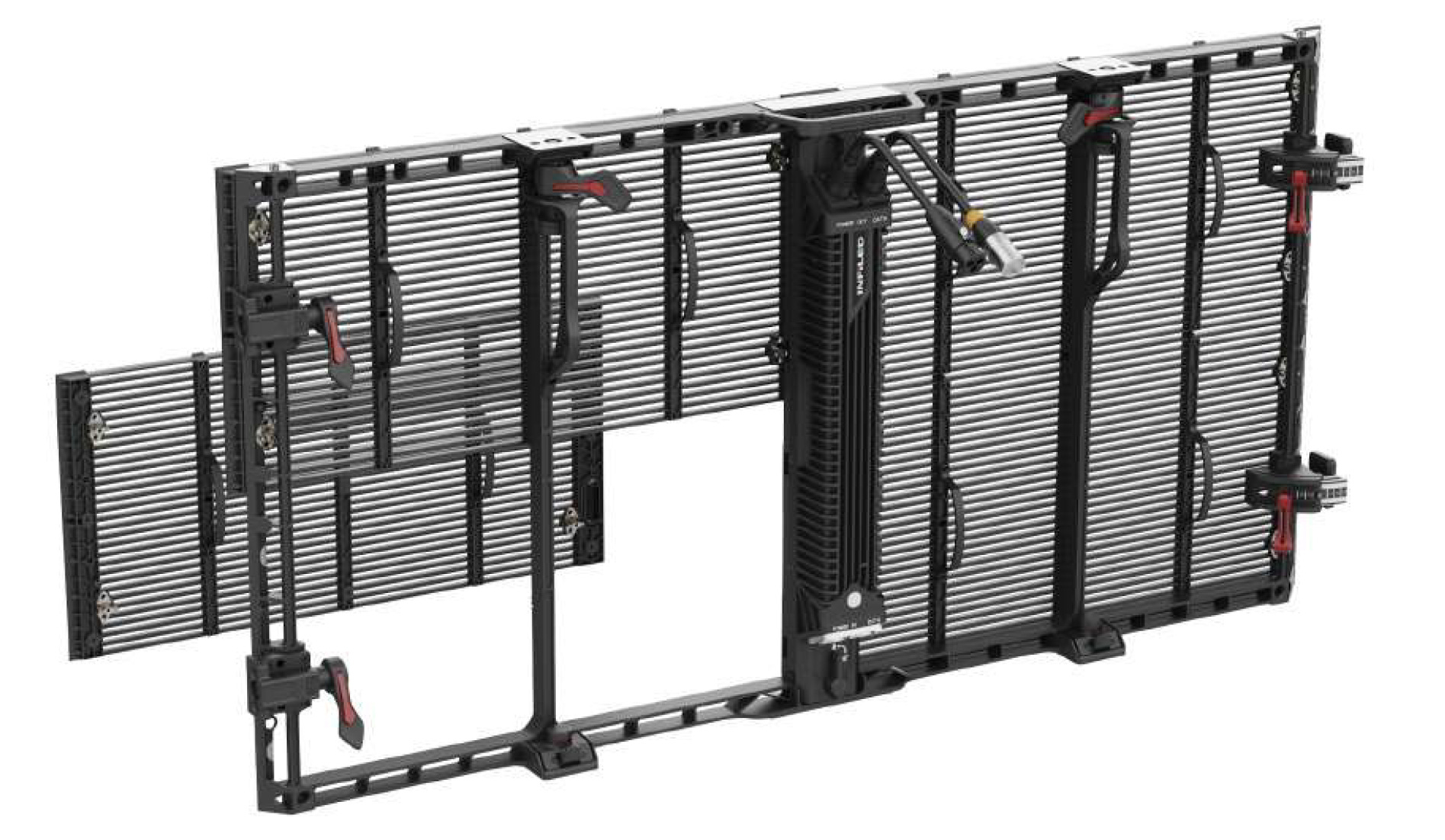
Front and rear service access is important when the LED curtain is used as:
an external booth wall,
a curved surface,
a tall scenic element,
a cube,
a closed or semi-closed structure.
Before finalizing the design, ask:
Can technicians reach the rear side?
Is front service possible?
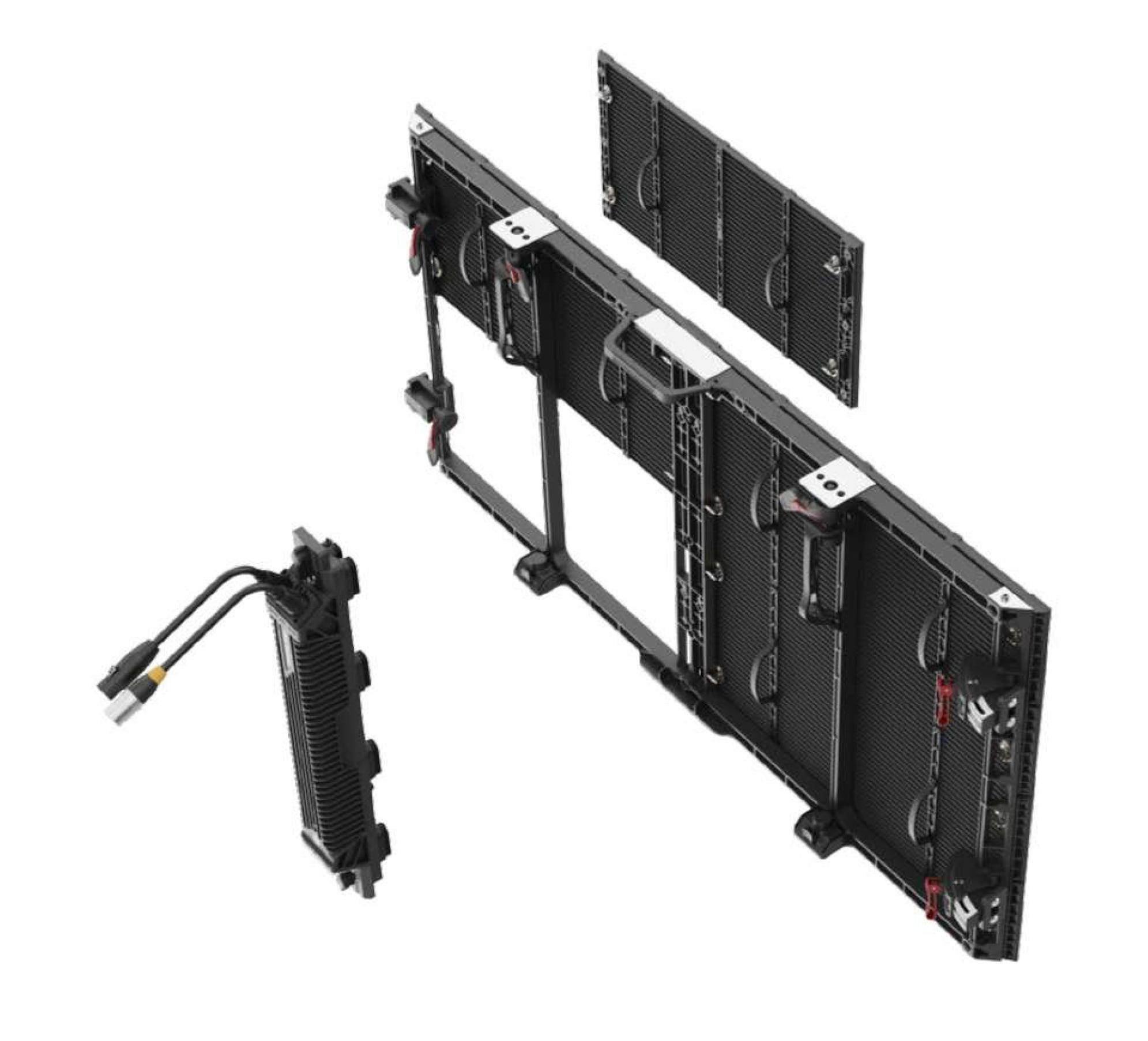
Where are the control units?
Can a module be replaced without dismantling half the structure?
Are cable routes accessible?
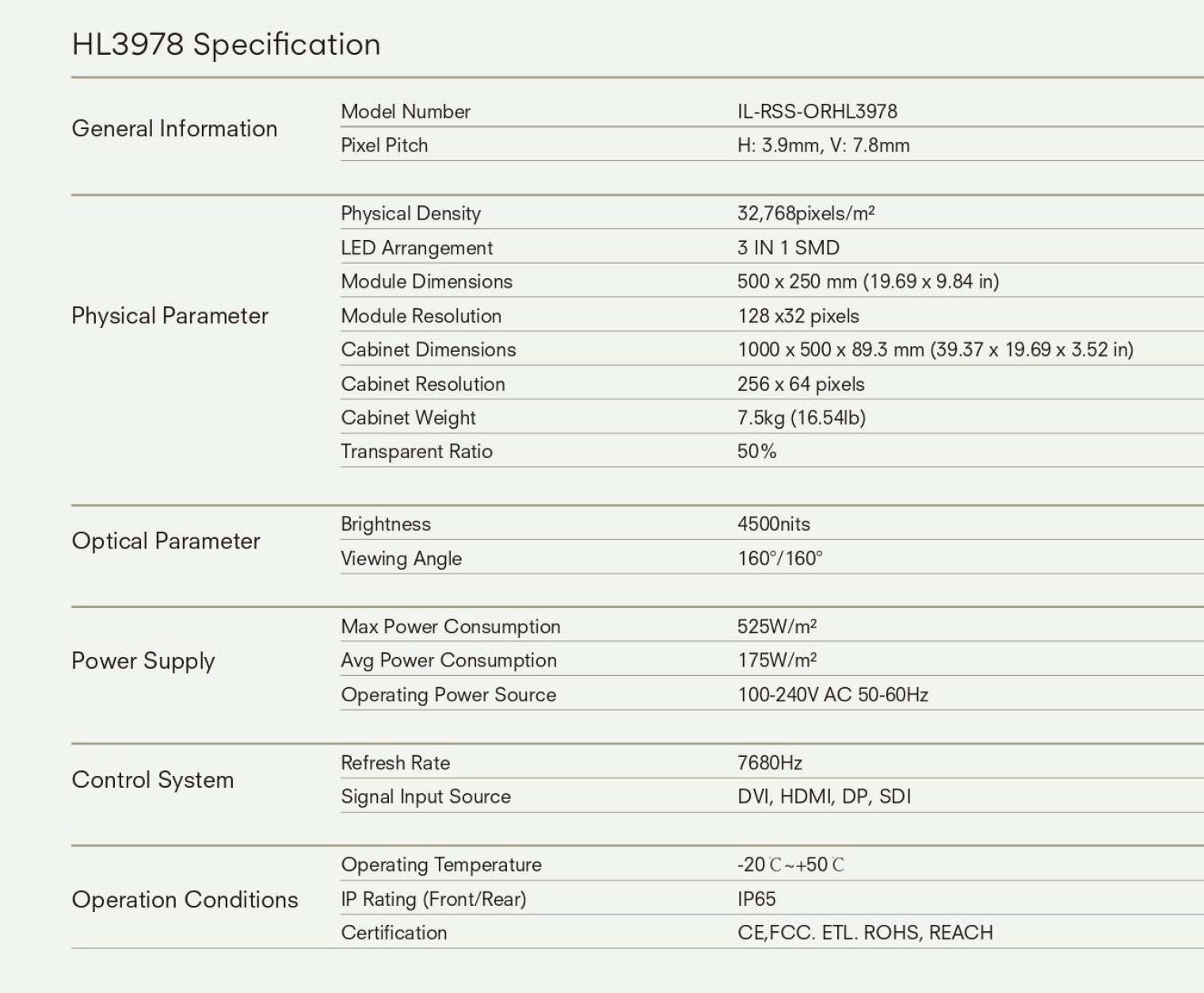
Key technical parameters
For designers, not every specification is equally important.
The most relevant key parameters:
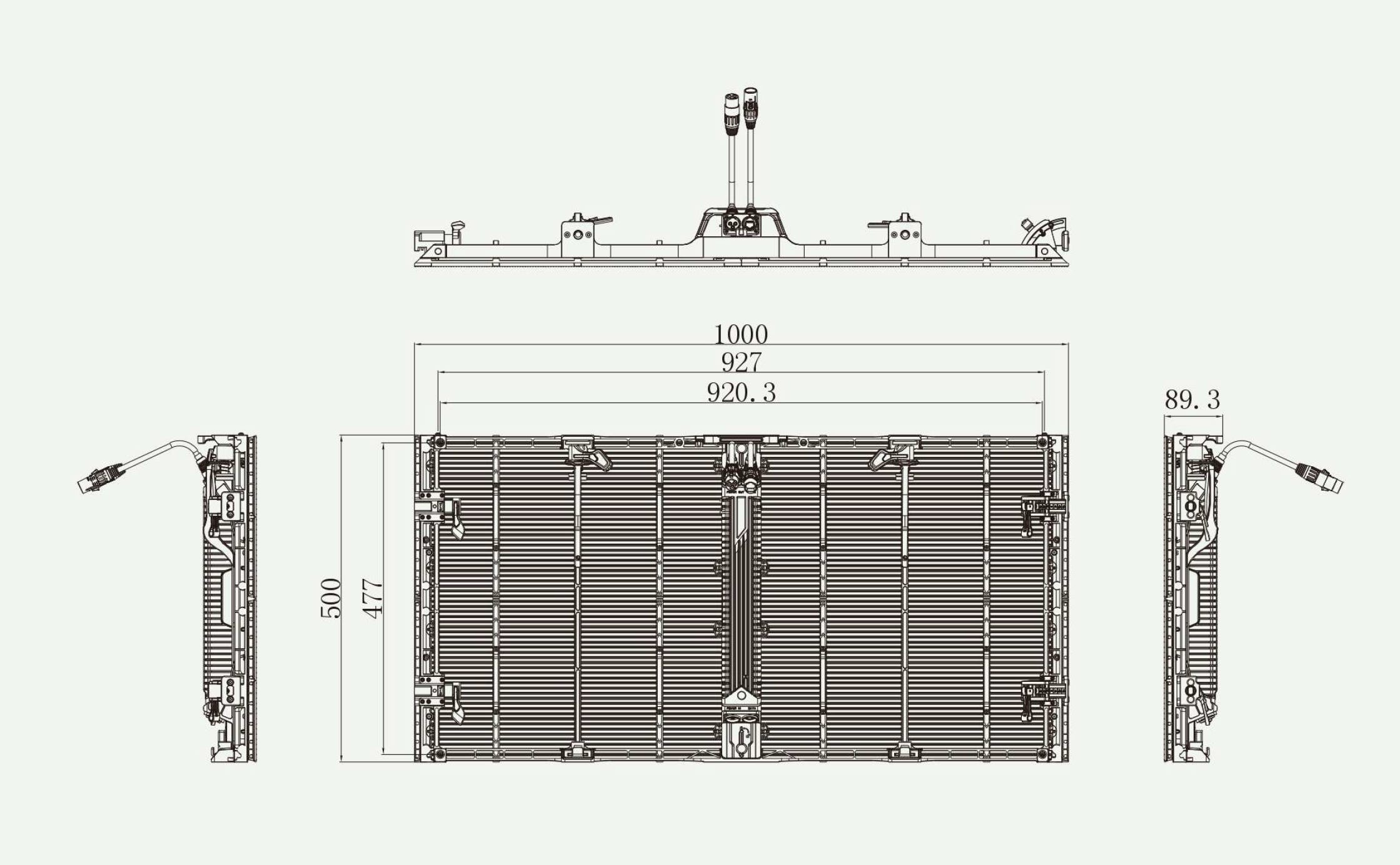
1000 × 500 mm cabinet size
50% transparency
7.5 kg cabinet weight
4500 nits brightness
7680 Hz refresh rate
IP65 front/rear rating
3.9 mm / 7.8 mm pixel pitch
These parameters come from the INFiLED HoloLight HL3978 material prepared for A-RENTAL’s transparent curtain system.
For exhibitions and live events, the 7680 Hz refresh rate is especially important. A high refresh rate helps reduce visible flicker on smartphones and cameras.
That means the structure looks better not only live, but also in social media content, press materials and video documentation.
NovaStar A8s Pro and COEX
In A-RENTAL’s configuration, the modules use NovaStar A8s Pro receiving cards.
This matters because A8s Pro allows virtual image rotation inside the receiving card.
That gives technicians more flexibility when working with unusual layouts, non-standard structures or mixed scenic shapes.
The system also works with NovaStar COEX, which supports modern LED workflows, signal management and professional control environments.
In simple terms: The system is flexible physically and digitally.
That is important when the LED structure is not just one flat rectangle.
For teams searching for creative LED rental equipment for trade shows, concerts, brand activations and corporate events, this combination of transparent LED and high-resolution displays is often the most flexible starting point.
Further reading
For more examples, technical inspiration and rental applications, explore:
Transparent LED curtain rental solutions for exhibitions, concerts and multimedia scenography
Modern multimedia exhibition stands and modular LED booth structures
Practical event technology insights for multimedia stages, exhibition stands and live production